
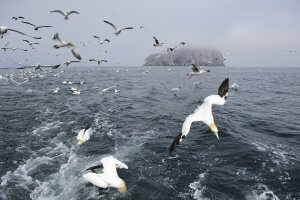
Gannets diving for fish, Bass Rock, Forth and Borders Area. ©Lorne Gill
This project was two fold. The first aspect carried out analysis, interpretation and reporting of drone surveys, trail camera monitoring footage and productivity data from the Scottish Seabird Centre Bass Rock fieldwork associated with the 2025 monitoring programme. This has resulted in the production of two reports presenting the methods and results of the ‘Count of Northern Gannets on the Bass Rock in July 2025’, and the analysis of ‘Productivity Monitoring of Northern Gannets on the Bass Rock in 2025’ and a set of recommendations for future monitoring approaches. The full 2025 Bass Rock Count Report can be found on the Scottish Seabird Centre website.
The analytical component of the project required several weeks of detailed manual work. This included reviewing and analysing productivity data collected throughout the 2025 gannet breeding season from large quantities of photographs generated by trail cameras deployed at monitoring plots. From these, Apparently Occupied Nests were identified from which breeding success was calculated. As part of the process, two remote observation techniques were trialled for monitoring productivity (web cameras and trail cameras), each of which required its own monitoring method. Both techniques were interrogated for their use in collecting productivity data and informed the output of a new set of methodology for the 2026 breeding season.
The second aim was to acquire, set up and trial the use of two 360-degree camera systems on Bass Rock for use in conservation science, citizen science and public engagement. The cameras are being used to support conservation science, citizen science and public engagement during the 2026 gannet breeding season, and beyond.
Camera systems of this kind have not been used to observe seabirds – or indeed other wildlife – before. This trial has demonstrated their viability, and over the 2026 season we will learn more about their reliability, performance and suitability for various uses.
A live stream of the cameras will also be available to view at the Scottish Seabird Centre, and on their YouTube channel, to support deeper public connection with the Bass Rock gannet colony.
In 2025 SMEEF was able to provide a grant of £68,599 to support this work using resources from the Nature Restoration Fund.