
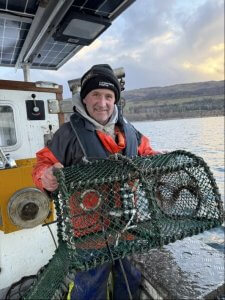
Creeling for Sounds was a pilot project led by the Hebridean Whale and Dolphin Trust. Over the winter months, project officer Hannah worked closely with local creel fishermen to test whether it was possible to collect acoustic data alongside active fishing gear.
Knowledge of year-round distribution of whales, dolphins and porpoises (collectively known as cetaceans) in Scottish waters remains limited, particularly over the winter months. Yet this information is essential if we are to understand how species use our waters year-round. Noise pollution is a significant threat to marine life and our seas are becoming increasingly noisy as human activity intensifies the soundscape. Passive Acoustic Monitoring (PAM) offers a consistent way to monitor cetacean presence and better understand how our activities are affecting marine soundscapes. PAM is particularly useful for assessing the impacts of underwater noise on cetacean distribution and behaviour.
One of the most significant outcomes of the project has been its collaborative impact. Engagement extended beyond active fishers to the wider community including harbour users, residents and businesses showing support of the project. Through these positive interactions, alongside word of mouth and growing social media presence, the project has attracted further interest from the fishing community across the west coast of Scotland and from other marine sectors such as seaweed farming.
In 2025 SMEEF was able to provide a grant of £29,937 using resources from the Nature Restoration Fund.