
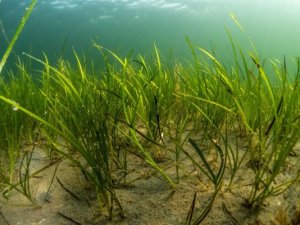
UHI Shetland’s project to search for Shetland’s lost seagrass established a baseline map through science-led community surveys of seagrass beds and shallow maerl habitats. Seagrass habitats are important productive and biodiverse marine habitats, but their status is vulnerable as a result of extensive loss throughout the UK. Accurate knowledge of the current distribution of seagrass habitat is important to inform management, restoration assessments and blue carbon storage calculations. This study investigated the historic and current distribution of seagrass in the Shetland Islands.
Historic records of seagrass from across Shetland were reviewed to identify prioritised areas to assess for presence of subtidal Zostera marina (eelgrass) beds. Unmanned Aircraft Systems (UASs or drones) were used to survey identified sites. The use of UASs to map and monitor seagrass is rising in popularity, as they offer a time- and cost-effective means to gather high-resolution aerial imagery across large areas. Manual analysis of aerial images identified suspected seagrass bed locations which were ground-truthed via paddleboard and snorkel surveys with photo and video transects carried out by community volunteers.
The project demonstrated the applicability of small, relatively inexpensive UASs to cost- and time-effectively survey and map subtidal seagrass habitats. This method is particularly useful in remote and hard to access areas with highly complex coastlines such as the Shetland Islands. The benefits of accessible historic survey reports and local records for informing current surveys and identifying historic baseline distributions are emphasised, and it is important that all contextual information is preserved if historic data is to be used to guide future restoration efforts.
In 2023 SMEEF was able to provide a grant of £7771 to support this work using resources resources donated by businesses to SMEEF.