
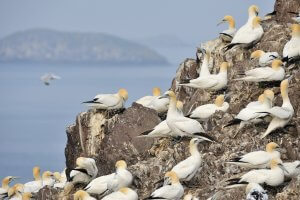
For more than 20 years the Scottish Seabird Centre has been helping people to learn about Scotland’s marine wildlife, habitats and iconic seabirds. Their base on the edge of the Firth of Forth in the seaside town of North Berwick, East Lothian gives them unparalleled access to amazing coastal seascapes and underwater environments. These include the Bass Rock which supports the world’s largest colony of northern gannets.
SMEEF funded GPS GSM tags, a thermal camera, temperature loggers and a portable weather station that was used for two master research projects with the University of Glasgow. The thermal ecology equipment was predominantly used by students who collected the data for a study on heat stress in gannets. Climate change related changes in the microclimatic environment of breeding seabirds and the consequences for their physiology continues to be a very important research topic with direct relevance for conservation management.
The GPS GSM tags were deployed on breeding pairs to study gannet attendance patterns and their impact on heat stress in gannet chicks in parallel to the thermal observations. However, the High Pathogenicity Avian influenza (HPAI) outbreak that started on the Bass Rock in June 2022 severely disrupted the planned research. Serendipitously the team were able to track gannet movements during the outbreak, generating a truly unique dataset. It showed that surviving birds exhibited exceptional long-distance movements including visits to other gannet breeding colonies, a behaviour that has so far never been recorded for adult breeders. The team hypothesize that the severe disruption in the breeding colony, as well as the loss of partner and chick triggered these exceptional movements, and highlighted these as a possible pathway of rapid long-distance transmission of HPAI in seabird colony networks. These findings were shared in scientific reports and presented them at the 8th International Biologging Science Symposium in Tokyo in 2024.
In 2021 SMEEF was able to provide a grant of £59,829 to support this work using resources from the Nature Restoration Fund.