
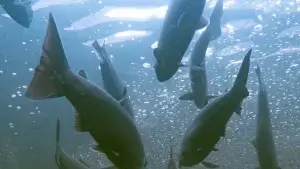
Two Scottish Parliamentary enquiries indicated that there was insufficient information on the migration pathways of salmon smolts as they leave their natal rivers and migrate out to their open ocean feeding grounds. Through understanding these migration pathways, a more effective regulatory system can be devised for offshore developments such as aquaculture and marine renewables around the west coast of Scotland.
The West Coast Tracking Project (WCTP) was established to better understand those migration pathways. This project measured how long smolts take to migrate through coastal zones on the west coast of Scotland, observing smolt movements through sea lochs to inform future management. The final design included the trapping and tagging of 1100 smolts at 12 locations, and deployment of 330 acoustic receivers in rivers and sea lochs. Receivers deployed by the WCTP covered ~77-80km/sq of seabed and inland waters.
In 2022 SMEEF was able to provide a grant of £84,632 to support this work using resources from the Nature Restoration Fund.